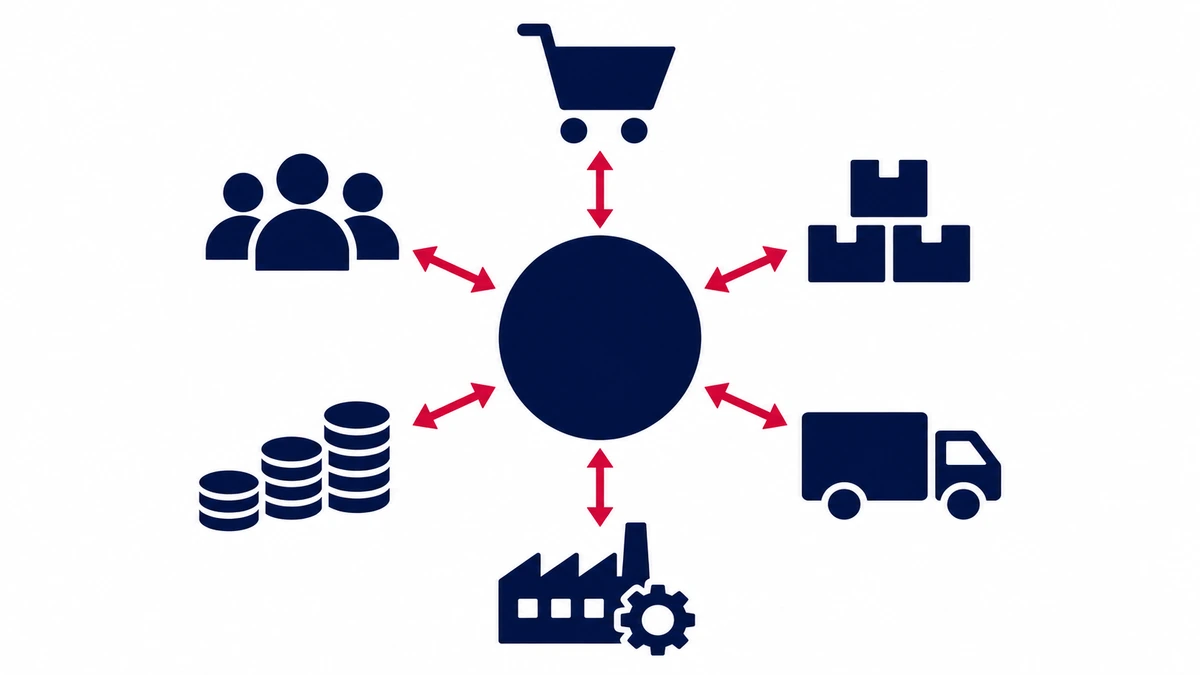
Short answer: ERP (Enterprise Resource Planning) is software that records purchase, stock, sales, production, accounts and staff in one shared database, so every department works from the same numbers. ERP software for small business in India usually starts with three or four modules and must handle GST e-invoicing, godown-wise stock and payment deadlines to MSME suppliers.
- Many micro businesses do not need an ERP yet; billing and accounting software is enough.
- The trigger is people chasing information: stock that never matches, orders lost in WhatsApp, supplier dues missed.
- Routes: accounting plus add-ons, packaged or open-source ERP, or custom ERP.
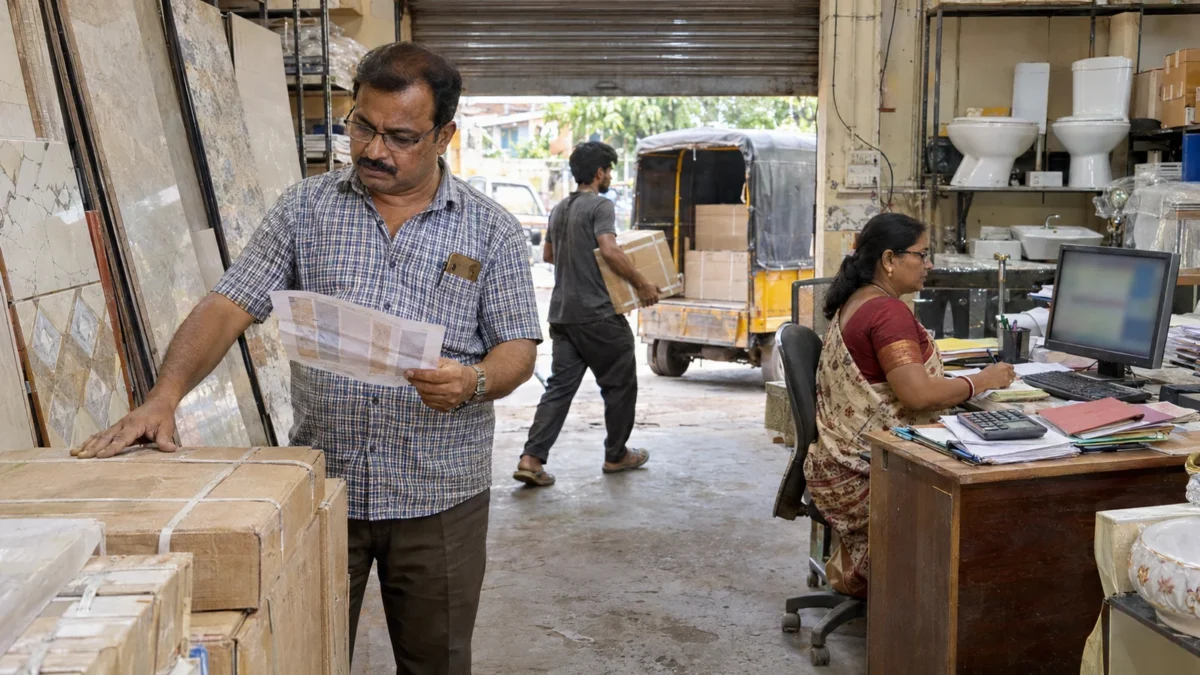
On the last evening of the month, the accountant at a hypothetical tiles distributor in Berhampur has three stock figures that do not agree: the software’s, the godown supervisor’s count, and what sales promised on WhatsApp. Each person kept a separate record, and an ERP exists to make them one. We build custom ERP software, so weigh our view with that in mind.
What is ERP, and what is its full form?
The full form of ERP is Enterprise Resource Planning. An ERP is a set of connected modules, one for each area of work such as purchase, inventory or payroll, that all read and write the same database.
Say the dispatch clerk in that Berhampur godown marks forty boxes of floor tiles as loaded. The godown stock drops, the invoice is ready to raise, and the salesperson sees the order as dispatched, without a phone call.
For an MSME (micro, small or medium enterprise), ERP is mostly about recording each step once, by the person who does it.
What does ERP software for small business do day to day?
ERP software for small business follows an order from enquiry to payment, and each department adds its step to one shared record. The accountant reviews entries instead of retyping them.
- Sales order: stock and the customer’s credit limit are checked before confirming.
- Purchase order: raised when an item falls below its reorder level.
- Goods receipt: stores record what actually arrived, by godown.
- Production: raw material is issued against a recipe of parts.
- Dispatch: the GST invoice, e-invoice and e-way bill come from this entry.
- Payment: receipts and supplier payments update the ledgers.
Here is where a typical Indian MSME leaks money or stock, and what an ERP changes.
| Stage | What goes wrong today | What the ERP records | What the owner sees |
|---|---|---|---|
| Stock across godowns | Software stock never matches the count | Godown-wise stock; each transfer needs a sender and receiver entry | Variance and negative-stock alerts |
| Sales orders | Orders sit in WhatsApp; promises exceed stock | Orders booked against available stock, with a credit check | Pending orders by customer |
| Purchase | Supplier bills paid without checking what came | Purchase order, goods receipt and bill matched | Mismatch list before each payment run |
| MSME supplier dues | Due dates live in the accountant’s memory | Acceptance date and legal due date per bill | Ageing of micro and small supplier dues |
| GST invoicing | Invoices typed twice; e-invoices batched late | Invoice raised from dispatch and sent to the portal | Invoices still waiting for an IRN |
Key ERP terms
- Master data: the fixed lists every module uses, such as items, customers and godowns.
- GRN (goods receipt note): the record of what actually arrived.
- BOM (bill of materials): the raw materials needed to make one unit of a product.
- IRN (Invoice Reference Number): the unique number the GST Invoice Registration Portal returns for each e-invoice.
- Audit trail: a log of who created or changed each entry, and when.
Do you need an ERP yet?
You need an ERP when your people spend more time chasing information than acting on it. While one person can see stock, orders and dues without phoning anyone, you probably do not need one.
You can wait if you have one counter and one godown, the owner approves every purchase, stock matches when counted, and there is no production.
You are ready if two or more of these are true:
- Two or more godowns or branches, with transfers agreed by phone.
- Several salespeople, with orders living in chats.
- Job work or production you cannot trace from raw material to finished goods.
- Nobody knows which micro or small supplier bills are past their legal due date.
- Invoices keyed into a second system to get the IRN.
Three hypothetical MSMEs
The Berhampur distributor needs inventory, sales orders and an accounting link first. Production modules would be wasted money.
A fabrication job shop in Rourkela needs purchase, BOMs and job tracking. As a small enterprise itself, it also wants receivables showing which buyers have crossed the payment period the MSMED Act allows.
An appliqué work shop in Pipili with one counter and a small online store does not need an ERP. Billing software with stock will serve it for years.
Which MSME rules does an ERP help you keep?
An ERP does not make you compliant, but it holds the dates and records three common rules depend on. This is where ERP for MSMEs differs from generic ERP advice.
Udyam registration and classification
Udyam Registration is the Ministry of MSME’s registration for micro, small and medium enterprises. According to the Udyam Registration portal, it is free, paperless and based on self-declaration, with investment and turnover details taken from PAN and GST-linked government data.
Classification uses investment and turnover; the limits were revised from 1 April 2025, and the portal lists the current figures. In an ERP, Udyam status belongs in every supplier record, for the reason below.
Paying micro and small suppliers on time
Section 15 of the Micro, Small and Medium Enterprises Development (MSMED) Act, 2006 requires a buyer to pay a micro or small supplier by the date agreed in writing. That agreed period cannot exceed 45 days from the day of acceptance or deemed acceptance of the goods or services.
- No written agreement: payment is due before the “appointed day”, the day after 15 days from acceptance.
- Acceptance: normally the day of delivery; a written objection within 15 days moves it to the day the objection is removed.
- Late payment: section 16 adds compound interest with monthly rests at three times the bank rate notified by the Reserve Bank of India.
- Disclosure: section 22 requires buyers with audited accounts to show unpaid amounts and interest in their annual accounts.
An ERP helps by treating the GRN date as acceptance, storing written objections and calculating each bill’s due date. Unpaid suppliers can approach their state’s Micro and Small Enterprises Facilitation Council; the MSME Samadhaan portal now directs new delayed-payment applications to the MSME ODR Portal.
GST e-invoicing once it applies
GST e-invoicing applies to a registered business whose aggregate turnover in any preceding financial year from 2017-18 onwards crossed the notified limit, for invoices to registered buyers and exports, with some exempt categories. The GST e-invoice portal explains that the Invoice Registration Portal (IRP) returns an IRN, a digitally signed e-invoice and a QR code for each invoice reported.
As of November 2026, a GSTN advisory effective from 1 April 2025 stops taxpayers above a specified turnover band from reporting e-invoices older than 30 days. An ERP that sends each invoice to the IRP when it is saved avoids that risk.
This is general information, not legal or tax advice. Check how each rule applies to your business with your CA.
ERP for small business in India: your three options
The right route depends on how standard your process is and how much change your team can absorb.
| Route | Fits when | Watch out for |
|---|---|---|
| Accounting software plus add-ons | Books are fine; one or two gaps such as godown stock or orders | Entries typed twice if the add-on does not sync |
| Packaged or open-source ERP | Your process is close to the standard trading or manufacturing flow | Workarounds where your documents differ; upgrade effort after customising |
| Custom ERP | Your process sets you apart, or packaged screens force daily workarounds | Needs a written scope, documentation and source-code handover |
Tally Solutions lists inventory, GST, e-invoicing and payroll among TallyPrime’s features, so many MSMEs start the first route there. Free ERP software also exists: ERPNext publishes its code under the GNU GPL v3 licence, and Odoo under LGPLv3, according to their public code repositories. Free means no licence fee; hosting, GST set-up, data migration, training and support still cost money or staff time.
ERP benefits and the real challenges
The main advantage of ERP is one version of the truth for stock, orders and dues. The main challenge is that it only works if every department enters its step on time.
- Benefits: godown stock that matches the count; each entry made once; daily views of receivables and MSME supplier dues; e-invoices from the dispatch entry; an audit trail.
- Challenges: item masters with duplicate names and missing HSN codes; staff used to paper or Excel; over-customising until upgrades hurt; weak mobile data in godowns; vendor lock-in without written export rights.
What does it take to start an ERP?
An ERP needs an owner who decides, one internal champion, clean master data and a phased plan. Its cost depends on scope, not on the word “ERP”.
- People: the owner settles disputes; a champion, often the accountant, runs the rollout; one key user per department trains the others.
- Data: items with units and HSN codes, customers with GSTINs, suppliers with Udyam status, and opening stock per godown.
- Cost drivers: modules, users and branches; integrations such as e-invoice APIs or Tally; customisation; data migration; hosting; training; support.
Start with the two or three modules that fix your worst daily problem. One common misconception is that an ERP will fix a messy process; it records your process faithfully, faults included, so agree the process first.
What to check before you decide
Take this list to any vendor, SITS included, and ask for answers on your own data.
- List your five worst daily problems and ask which module fixes each.
- Ask for a demo using one real invoice, goods receipt and godown transfer.
- See e-invoices and e-way bills generated inside the software, and how portal errors appear.
- Check that supplier records hold Udyam status and payables show legal due dates for micro and small suppliers.
- If you are a company, confirm the audit trail logs every change and cannot be switched off.
- Agree data ownership and export in an open format in writing.
- Test the mobile screens on the godown floor with a weak signal.
- Get a named support contact, a training plan and a phased go-live plan in writing.
Where to go next
If you make products, see how manufacturing ERP software handles BOMs, work orders and job work. If you would rather meet in person, our ERP development team in Bhubaneswar works from Saheed Nagar.
How SITS can help
Swadhin IT Solutions (SITS India) has built custom software since 2013, including ERP, billing and GST, inventory and HR/payroll systems. We start with a requirement discussion and give a written estimate for the modules you actually need. Our ERP software development page explains how we work.
Frequently asked questions
What is ERP in simple words?
ERP is software that lets every department record its work in one shared system. Sales, purchase, stores, accounts and HR see the same numbers, so nothing is retyped or chased by phone. A small business usually starts with sales, inventory and accounts, and adds modules as it grows.
What is the full form of ERP?
The full form of ERP is Enterprise Resource Planning. The term covers software that plans and records how a business uses its money, materials, machines and people, through connected modules sharing one database. In colleges, “ERP” often means the campus portal where students log in, which is built on the same idea.
Is Tally an ERP?
TallyPrime is business management software, and Tally Solutions lists inventory, GST, e-invoicing and payroll among its features. Whether it works as your ERP depends on use. If sales, stores and purchase enter their own steps in it, you are close to ERP-style working. If the accountant types everything from paper slips, it is accounting software.
Do micro and small businesses need an ERP?
Not always. A micro business with one counter, one godown and an owner who sees every transaction does well with billing and accounting software. An ERP pays off with several godowns or branches, production or job work, several salespeople, or when supplier due dates and e-invoices start to slip.
Is there free ERP software for small businesses in India?
Yes. Open-source ERPs such as ERPNext, and the open-source code of Odoo, carry no licence fee. You still need hosting, GST and e-invoice set-up, data migration, training and support, from your own staff or a paid partner. For most small firms, those costs decide the choice.
How long does it take to start using an ERP?
It depends on scope and data more than software. A trader starting with sales, inventory and accounts, with clean item lists, can usually go live in phases over a few weeks to a few months. Manufacturing, several branches or heavy customisation takes longer. Insist on go-live criteria for each phase.