Full disclosure: we run a software company in Bhubaneswar, so we’re not a neutral party here. This is the checklist we’d hand our own clients to check us with.
Short answer: Here’s how to choose a software development company. Write a one-page brief before any meeting, shortlist three or four firms from reviews and referrals, then verify each one (registration, office, live apps, past clients). Choose the proposal that is clearest on scope, ownership and support. That is rarely the cheapest one.
Small-business software projects rarely go wrong in the code. They go wrong in the first fortnight, when a vendor is picked on a low quote and a nice demo and nobody writes down what’s being built. The same steps cover how to choose a mobile app development company, an ERP vendor or a web developer.
What should you prepare before you talk to anyone?
Prepare a one-page written brief before any meeting. Give it one evening; it saves weeks later.
Say you run a diagnostic centre in Cuttack. “We need an app” isn’t a brief. “Patients phone three or four times to ask if their report is ready, and the front desk can’t do anything else during the evening rush” is. The first gets you a shopping list of features. The second gets you a sensible proposal.
Write down six things:
- The problem. What’s slow, lost or repeated today, in one paragraph, in your own words.
- The users. You, staff, customers, field staff or parents. How comfortable are they with phones, and which language do they prefer?
- Must-have vs nice-to-have. Be strict: if you could run the business for six months without a feature, it’s nice-to-have.
- A budget range, for your eyes only. You needn’t share it in the first meeting, but knowing it stops you being talked into a bigger project than you meant to buy.
- A deadline, and the reason for it. “Before the admission season” is a deadline. “As soon as possible” isn’t.
- Who will run it day to day. Someone inside your business has to answer questions, test builds and train staff. Without that person, the project stalls whoever you hire.
That page is your brief. Send the same page to every company, so the quotes answer the same question. If you want to know which features push the effort up before you write it, see our guide to mobile app development cost in India.
How do you build a shortlist?
Build a shortlist of three or four serious candidates, not fifteen. Search “app development company in Bhubaneswar” on Google Maps or “IT companies in Bhubaneswar” on Justdial and you’ll get dozens of names. Finding names is easy. Filtering them is the work.
- Referrals. The most useful source and the most ignored. Ask your CA, your trade association or a business owner in another town what they’d do differently.
- Google Maps. Real offices near you, with reviews in one place.
- GoodFirms and Clutch. Both platforms vet reviews, and the reviews often describe the project itself. Few Odisha firms have many reviews there yet, so a thin profile on its own isn’t a red flag.
- Justdial. Handy for numbers and addresses. Ratings cover every kind of service, so read the text, not the score.
How to read reviews
- Recency. Glowing reviews from years ago and nothing recent can mean the people who earned them have left.
- Detail. “Very good service” could be about anything. “They built our stock app and fixed the GST invoice format the next day” is about something.
- Replies. Calm, specific replies to bad reviews are a good sign. Defensive or copy-pasted ones preview how you’ll be treated when something breaks.
- What the reviews are for. Many IT firms here also sell websites, bulk SMS or training courses. Happy SMS customers or students say nothing about building apps, so look for reviewers describing app or software work.
Many “Top 10 software companies in Bhubaneswar” articles are published by one of the companies on the list, which tends to sit at number one. Directories also sell sponsored spots. Read those pages as advertising. The same goes for any list we might publish.
How do you verify a software company?
Check its registration, office, live apps and past clients. Allow an hour or two per company; most checks are free.
- MCA company search. If the firm calls itself a Pvt Ltd or LLP, look it up in the free company master data search on the Ministry of Corporate Affairs website (mca.gov.in). It shows the registered address, the date of incorporation, whether the company is active or struck off, its directors, and the dates of its last balance sheet and annual general meeting. Genuine proprietorships and partnerships won’t appear there; for them, the GST check matters more.
- GST registration. Check their GSTIN with “Search Taxpayer” on the GST portal (gst.gov.in). The legal name should match the quote, the status should be active, and the address should be where they say they are. A small freelancer may not need GST, but any firm charging you GST must have an active number.
- An office you can visit. Drop in on a working day without much notice. You’re looking for people at desks doing real work, not just a reception counter and a meeting room.
- Years in operation. Compare the incorporation or GST date with what the website claims; the oldest Google reviews are another clue. Software needs support for years, so you want a firm that will be around for years.
- Live work you can install and open. Install two or three apps from their store links and use them. Check the “Updated on” date and the developer name under each app: if it’s the client’s business, the firm hands accounts over properly. If the only proof of an app is a screenshot in a PDF, it’s a drawing of an app.
- One or two past clients on the phone. Ask: was it on time, what went wrong, how did the firm handle it, and did you get the code? Every project has a rough patch. You’re checking how the firm behaved during theirs.
- Who actually writes the code. Ask to meet the developer or project lead. Some subcontracting is normal in this industry. Hiding it isn’t, because you need to know who holds your code and data.
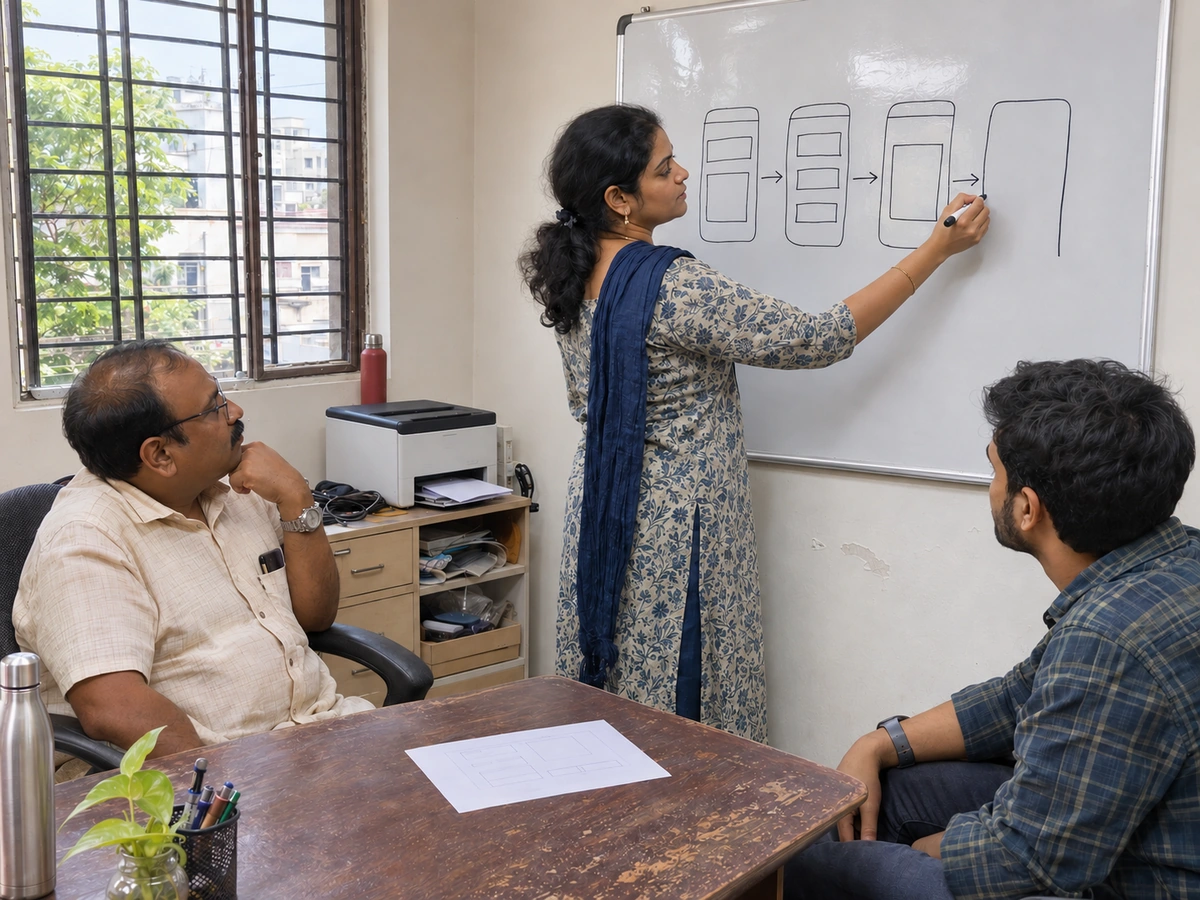
Questions to ask an app developer in the first meeting
You’re listening less for a perfect answer than for a straight one. Note their answers for when the proposal arrives.
| Question | What a good answer sounds like |
|---|---|
| Who will work on my project, in-house or outside, and can I meet them? | Names and roles, and the lead developer joins a meeting before you sign. |
| What will you need from us, and when? | Content, sample data, logins and a few hours of a decision-maker’s time each week. |
| What would you leave out of the first version? | They trim your list. A firm that agrees to everything hasn’t read it properly. |
| Native, Flutter or React Native, and why? | A reason tied to your app (camera use, offline working, iPhone users or not), not just their favourite tool. |
| How will you test it, and on which phones? | Real budget and mid-range Android phones, plus test builds you install before launch. |
| How will I see progress? | A working build every week or two, one named contact, and decisions confirmed in writing, not just on WhatsApp. |
| What if I change something halfway? | A written change request showing the effect on time and cost, approved by you first. |
| Whose name will the Play Console, App Store, domain and hosting accounts be in? | Yours, from day one. They get access as users. |
| When do I get the source code? | At milestones, or at final payment at the latest, in a repository you own. |
| What does post-launch support cover, and not cover? | A written bug-fix period, then optional maintenance, with a clear line between a bug and a new feature. |
| What could make this project late? | Specific risks: store review delays, payment gateway approval, your content arriving late. “Nothing” isn’t an answer. It’s a warning. |
| What will it cost to run each year? | A list of recurring items: hosting, store accounts, SMS or WhatsApp charges, maintenance. |
What red flags should make you walk away?
Walk away when two or three of the signs below show up together. One of them alone might have an innocent explanation.
- A firm price on the first call, before anyone has asked how your business runs.
- Reluctance to put scope in writing. “Don’t worry, we’ll handle everything” usually ends in an argument.
- Your app published under the agency’s developer account, or your domain registered in their name.
- No source code handover for custom work.
- Guaranteed first-page Google rankings or downloads thrown in. Nobody can promise where Google will rank you, not even Google.
- Pressure to pay the full amount upfront, or a “special price, today only”.
- A copied or unverifiable portfolio: apps on no store, clients who won’t take a call, screenshots that turn up on design sites under someone else’s name.
- A salesperson who says yes to every technical question, and no technical person ever turns up.
- No mention of testing, training or life after launch.
How to choose a software development company from its proposal
Ask each shortlisted firm for a written proposal against the same brief. A good one covers:
- Scope: what each type of user can do, plain enough that you could test it.
- Screens or modules, ideally with rough wireframes of the main ones.
- Platforms: Android, iOS, web, and the admin panel your staff will use (often forgotten, almost always needed).
- Milestones: what you receive at each stage, when, and which payment is tied to it.
- Exclusions: content, store fees, hosting, SMS and payment gateway charges. Read this list twice.
- Testing, the support period, and ownership of code, accounts and data.
Put the proposals side by side, one row per item. Where a proposal is silent, ask. Silence usually means “not included”.
The cheapest quote is often cheapest because it covers less: no admin panel, little real testing, a template with your logo on it, or code you’ll never own. Say a school in Berhampur picks the lowest quote for a parent app. It works on the demo phone. On result day every parent logs in at once, it falls over, and the developer has moved on to another job. A second firm is paid to understand the code, often to rewrite it. Two bills for one app.
Software development contract checklist
This isn’t legal advice; for a large project, have your lawyer read the agreement. These are the points we’d expect in any contract:
- Source code delivered into a repository (GitHub, GitLab or similar) owned by your business.
- Accounts in your name: Google Play Console, Apple Developer, domain, hosting or cloud server, Firebase, payment gateway, SMS and WhatsApp sender accounts. Google and Apple both ask for a D-U-N-S number when you register as an organisation, so start early.
- An NDA signed before you share customer lists or anything sensitive.
- An IP clause: custom work becomes yours once paid for. A firm may keep its own reusable components if you get a permanent licence to use them.
- Payment by milestones, each tied to something you can see and test.
- A warranty or bug-fix period, with a written definition of a bug.
- AMC terms: what’s covered, response times, renewal, and what happens if you don’t renew.
- Personal data: how they’ll handle customer and staff data under the Digital Personal Data Protection Act, 2023, and how it’s returned or deleted at the end.
- An exit clause: what they hand over if you part ways, and how quickly.
Agency, freelancer, national firm or ready-made software
Before choosing a firm, make sure you’re choosing the right kind of supplier.
| Option | Good fit for | Control | Support | Accountability | Risks |
|---|---|---|---|---|---|
| Local agency | Software used for years, with meetings and staff training | High, if code and accounts are in your name | In person and by phone; a team covers when someone leaves | A registered business with an office you can walk into | Quality varies widely; some quietly subcontract |
| Freelancer | Small, well-defined jobs, prototypes, fixes | High on paper; depends on the handover | One person’s time and health | Personal, with little recourse | A new job or bigger client can stall your project |
| National firm (Bangalore, Pune, Delhi) | Large, complex products needing formal process | Good, through contracts | Structured, usually remote | Strong contracts and a reputation to protect | Small projects may get junior teams; site visits are rare |
| Ready-made SaaS | Standard processes: billing, appointments, fee collection | Low: you use what the vendor builds | Vendor helpdesk | Subscription terms you can’t negotiate | Price changes, fixed features, limits on exporting your data |
Off-the-shelf products already cover a lot of billing, appointment and fee-collection needs. If one fits your process, subscribe and spend your budget elsewhere. Our custom software development page covers when building makes sense.
Is a local or a remote team better?
A Bhubaneswar address doesn’t make anyone a better developer. It makes them easier to visit, and sometimes that’s worth a lot. A local team helps when:
- You need workshops to map how your business actually runs. An afternoon watching your front desk beats ten video calls.
- Your users speak Odia, and screens, SMS and WhatsApp messages should read as if someone from Odisha wrote them.
- Staff need on-site training, or there’s hardware: barcode scanners, receipt printers, biometric attendance devices.
- The app must work on patchy 4G in the districts, and someone should test it there, not on office fibre.
Location matters far less when the product is well specified, your team is happy on video calls, and the work needs a specialist skill. A manufacturer in Jharsuguda building a dealer portal, say, should pick whoever has built one before, wherever they sit.
Where SITS fits
Swadhin IT Solutions has been building software since 2013, and our office is at Plot No. 746, Saheed Nagar, Bhubaneswar. We build Android and iOS apps, web applications and business software such as ERP, CRM and billing systems. You can see how we approach apps on our mobile app development in Bhubaneswar page, our software work on the software development company in Bhubaneswar hub, and the rest of what we do on our IT company in Bhubaneswar page. Run this checklist on us exactly as you would on anyone else.
Frequently asked questions
How many quotes should I get?
Three or four, one from each firm on your shortlist. With one you have nothing to compare; with six you’ll spend a month in meetings. Send every firm the same written brief.
Should I pay upfront?
Pay an advance to start, not the whole amount. Tie the rest to milestones you can see and test, and hold the final payment until the source code and accounts are handed over. Paying everything before work starts puts all the risk on you.
Freelancer or agency for a small app?
For a small, well-defined app, a good freelancer can do the job. If staff or customers will rely on it daily for years, an agency is usually safer, because support doesn’t depend on one person.
Who should own the source code?
You should, for custom software you’ve paid for. Write it into the contract and have the code delivered into a repository you control. With ready-made software you subscribe to, you own your data, not the code, so check how you’d export it.
How long should support last after launch?
At least through your first busy cycle, such as month-end or admission season, as a free bug-fix period in writing. After that, an annual maintenance contract makes sense: Android and iOS change every year, and an unmaintained app slowly stops working well.
Is a local Bhubaneswar company better than one in Bangalore?
Not automatically. A local team helps with face-to-face workshops, Odia-speaking users, on-site training and hardware set-up. For a well-specified product managed over video calls, choose on skill, references and contract terms instead.